Market in Japan Etiquette for Food Halls and Morning Markets
At a market in Japan, it is not always clear where you may eat, whether you should queue or how to ask about ingredients without holding up a stall. Department-store food halls and morning markets operate differently. The safest approach is to follow posted instructions, observe the individual stall and ask before assuming.
Market in Japan Etiquette for Food Halls and Morning Markets
Understand the setting before you buy
The word “market” covers several different places. Some primarily serve shoppers, others sell food for immediate consumption and some are working wholesale facilities with restricted public access.
| Setting | What to expect | Main etiquette consideration |
|---|---|---|
| Department-store food hall, often called depachika | Prepared meals, sweets, produce and food gifts, commonly on basement floors | Do not assume purchases can be eaten inside the sales area |
| Morning market, or asaichi | Independent stalls selling produce, preserved foods, crafts or prepared food | Keep narrow lanes clear and check where eating is permitted |
| Retail food or seafood market | Shops serving local customers alongside visitors | Distinguish browsing space, queues and designated eating areas |
| Wholesale market | Commercial trading, deliveries and controlled visitor areas | Stay within public areas and follow access restrictions |
Examples include Omicho Market in Kanazawa, Hakodate Morning Market and Takayama’s morning markets. Their layouts, products and visitor arrangements differ, so etiquette cannot be reduced to one national rule.
In Tokyo, Tsukiji Outer Market remains a retail and dining district. The former Tsukiji wholesale operations moved to Toyosu in 2018. Consult Tsukiji Outer Market’s official website for current visitor information.
Before choosing a market in Japan, check its current operating days, visitor access and food options. “Morning market” does not guarantee that every stall opens together or trades throughout the morning.
Eating etiquette at a market in Japan
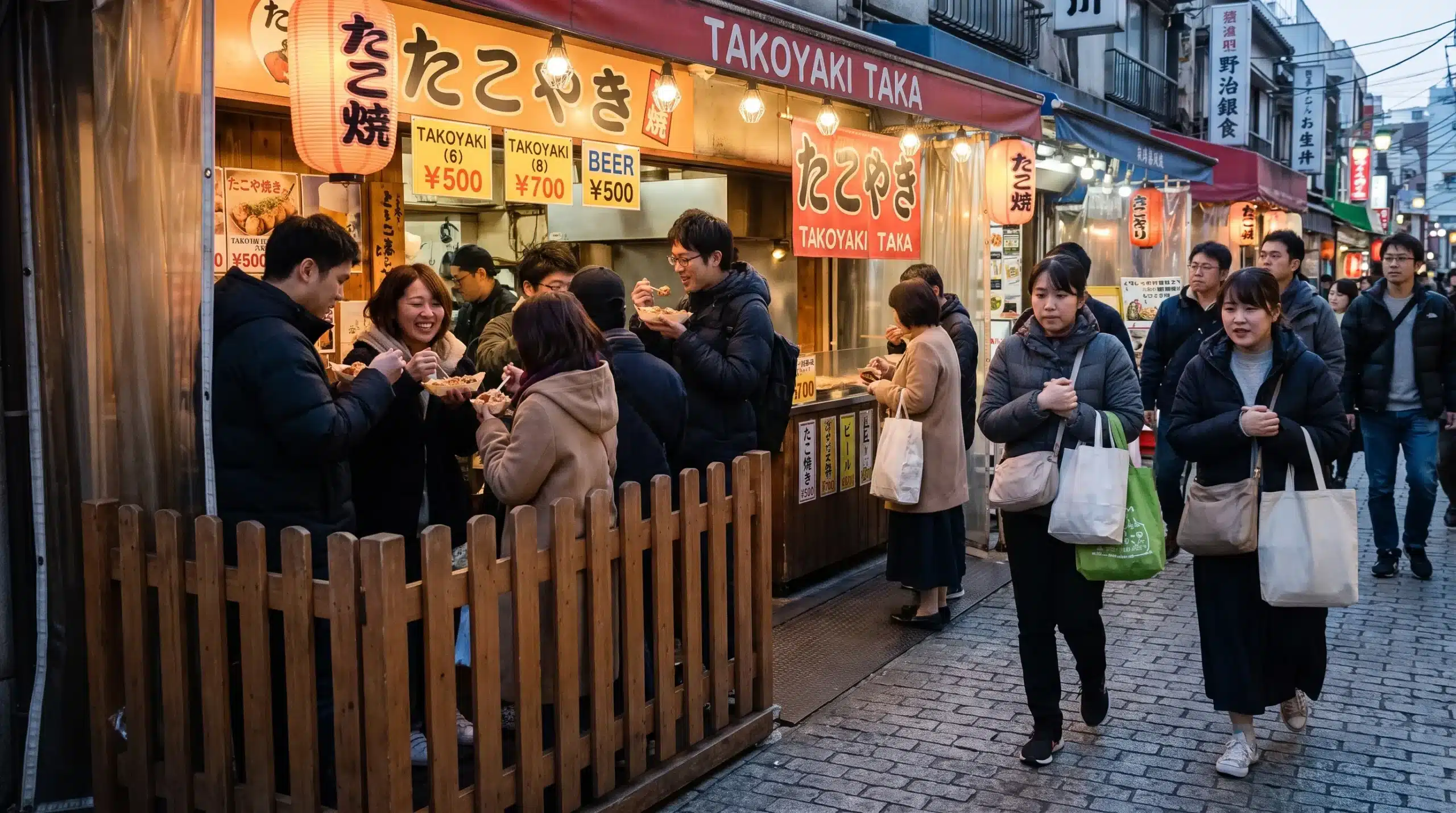
Buying ready-to-eat food does not automatically mean you may eat it anywhere nearby. Ask the seller where customers should stand or sit, then use that space without blocking another business.
Walking while eating is discouraged in many crowded market lanes and may be prohibited by local rules. This is not a blanket national ban. The practical issue is avoiding spills, collisions and disruption to people shopping or working.
In a department-store food hall, seating may be absent, limited or reserved for a particular counter. A department store may have a separate dining area, but do not assume an upper-floor terrace permits food consumption. Check signs or ask staff.
Samples are an invitation, not a self-service entitlement. Take them only when offered or clearly provided for customers. Do not touch displayed food, open containers or handle produce unless the seller indicates that this is acceptable.
At any market in Japan, finish eating and deal with the packaging before continuing through busy lanes. Ask the selling stall where its waste belongs; another shop’s bin is not automatically available for your rubbish.
Ordering, payment and queues
Pause briefly before joining a line. A queue may be for ordering, payment, collection or restaurant seating. When the arrangement is unclear, point to the counter and ask staff rather than joining whichever group appears closest.
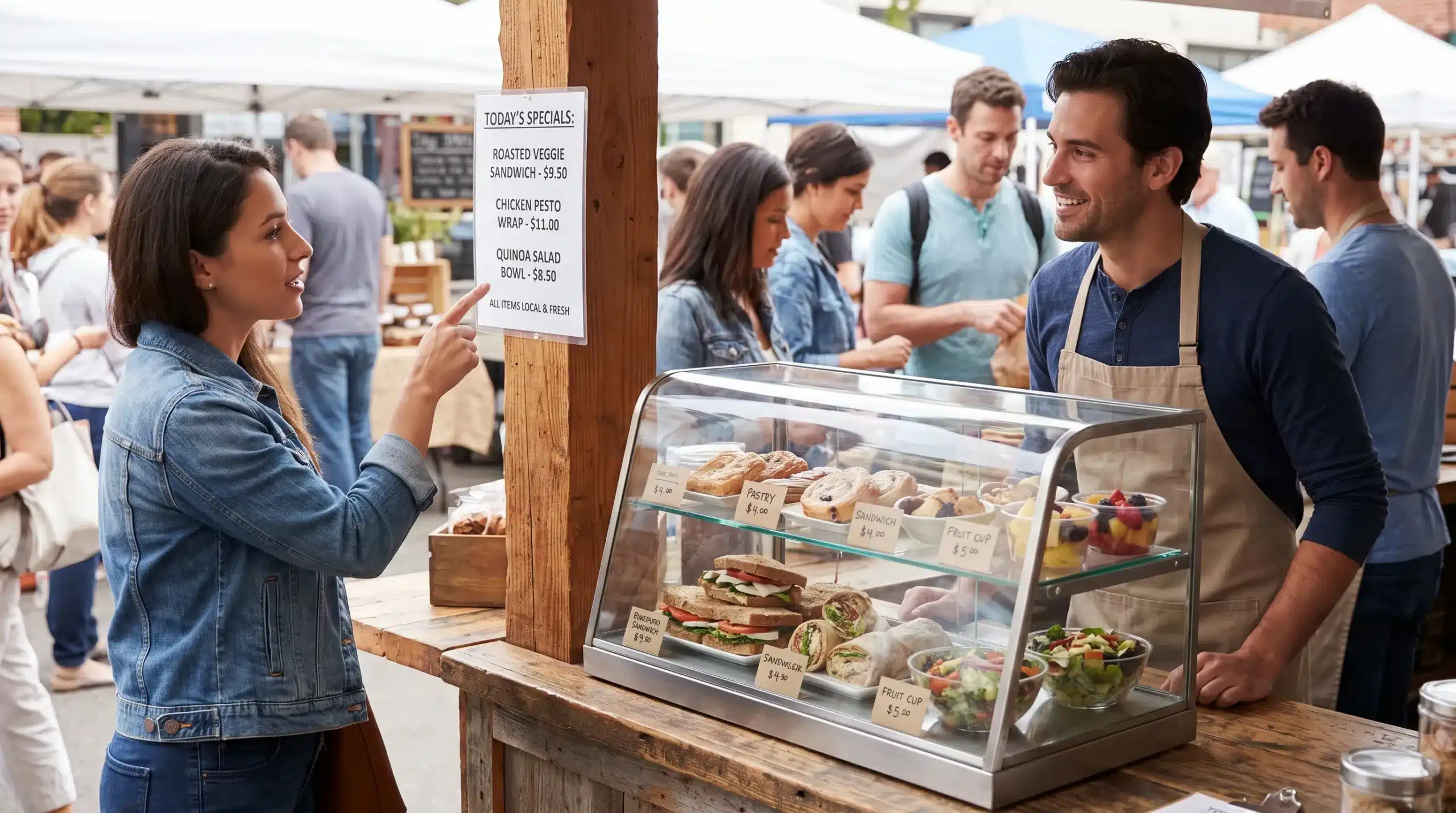
Decide what you want before reaching the front where possible. Pointing to an item and confirming the quantity is usually clearer than a long translated explanation. Check the displayed unit: an amount may apply to one item, a portion, a weight or a complete box.
Payment methods vary between stalls, even within the same market. Carry some cash as a backup and ask about cards before ordering. Use the payment tray where one is provided, then collect your change and belongings before moving away. Tipping is not expected for ordinary counter purchases.
Buying a small item does not entitle you to occupy a stall’s eating space indefinitely. If other customers are waiting, finish and make room.
For food to take away, say when you expect to eat it. Staff may explain storage requirements or offer suitable packaging. Do not assume that raw seafood or chilled prepared food can safely remain unrefrigerated during a day of sightseeing.
Dietary questions to settle before eating
An unfamiliar dish at a market in Japan needs an ingredient check, not a guess based on its appearance. Stock, sauces, marinades and garnishes can contain ingredients that are not obvious from the main food.
For allergies, show a clearly written Japanese explanation identifying the allergen and the need to avoid cross-contact. Ask whether the seller can verify ingredients, including bought-in sauces and seasonings. A busy stall may not have enough information or a preparation area suitable for your needs.
If the seller cannot confirm what is in the food or how it is prepared, do not treat uncertainty as reassurance. Translation software can help begin a conversation, but it cannot establish that a dish is safe.
Muslim visitors should not assume that seafood or vegetable dishes are halal. Cooking alcohol, meat-based stock, gelatin and shared preparation equipment may require specific questions. Likewise, vegetarian-looking food can contain fish stock.
Our article on navigating Japanese restaurants with allergies explains the communication issues in more detail. For advance enquiries, Japan Hand’s allergy and dietary handling support can help communicate requirements in Japanese. A helper cannot guarantee food safety or replace advice from your clinician.
At food halls, factory-packaged items may provide more written information than loose prepared food, but check the actual label. Do not assume every product carries an English translation or identical allergen information.
Photographs, bags and working space
Photography permission at one market in Japan does not establish permission at the next stall. Look for signs and ask before photographing sellers, customers or close-up displays. Buying something is not automatic consent to a portrait.
Do not lean over food to take a photograph, move price cards or step behind a counter. Avoid stopping for photographs in delivery routes, entrances or narrow junctions. Working markets need space for stock movement even when visitors are present.
Keep backpacks close to your body and take care when turning beside displays. Suitcases can obstruct queues and damage fragile goods. Where practical, leave larger luggage at your accommodation or use an appropriate storage facility before visiting.
With children, keep the family together without spreading across the lane. Explain beforehand that food, ice, tanks and utensils are not for touching. Ask about seating before ordering hot food that will be difficult to manage while standing.
Plan for mobility, seating and crowded spaces
A market in Japan may have uneven paving, wet floors, tight turns or long stretches without seating. A department-store food hall may offer lift access but still become difficult to navigate when crowded. Neither setting should be assumed accessible from its name alone.
Ask specific questions about the entrance, step-free route, accessible toilets and places to rest. Check the route from the station or car drop-off point as well as the market itself. A nearby station exit may involve stairs even when another exit has a lift.
For a quieter visit, ask the market or store which periods are generally less busy. Arriving at the earliest possible time is not always the answer: deliveries may be underway, stalls may still be setting up and facilities may not yet be available.
Crowd planning is practical support, not treatment for persistent anxiety or burnout. If travel forms part of a recovery plan, discuss it with your treating professional. Montgó Lifestyle’s professional support for stress and burnout is separate from the practical assistance a Japan Hand helper provides.
Useful phrases for brief, polite questions
A short question asked before ordering can prevent confusion. Say “sumimasen” to attract attention politely, then show the item or area you mean.
| Japanese phrase | Meaning |
|---|---|
| Koko de tabete mo ii desu ka? | May I eat here? |
| Shashin o totte mo ii desu ka? | May I take a photograph? |
| Kaado wa tsukaemasu ka? | Can I pay by card? |
| Doko ni narabimasu ka? | Where should I queue? |
Wait for the answer rather than treating the question as a formality. If you do not understand, show a written translation and allow staff time to respond.
At a market in Japan, a brief refusal may reflect limited space, uncertain ingredients or a rule the seller cannot change. Accept the answer without repeatedly asking another member of staff for permission.
Frequently asked questions
What is a Japanese market called? Ichiba is a common word for a market, while asaichi means morning market. Depachika refers to a department-store basement food hall. These terms describe different settings, not a single format with uniform rules.
Can I bargain at food stalls? Treat displayed retail prices as fixed unless the seller clearly invites negotiation. Bargaining is not the normal approach at department-store food counters or most visitor-facing food stalls. You may ask what a price includes without trying to negotiate it down.
Do I need a helper to visit a market? Usually not for straightforward browsing and purchases. A helper becomes more useful when you need detailed dietary questions, mobility planning or communication that a short translated phrase cannot resolve. Help cannot override restricted access or a seller’s refusal.
Arrange support for a specific task
For shopping assistance at a market in Japan, describe the location, date, language and task through the contact form on the Japan Hand website. Japan Hand operates nationwide, including regional cities, small towns, islands and rural destinations, with helpers available in a range of languages beyond English. State any dietary or mobility requirements in your request. The price depends on the specifics, and you will receive a quote before anything is agreed, with no obligation.