How to Navigate Japan Restaurants in Japan With Allergies
How to Navigate Japanese Restaurants With a Food Allergy
The phrase food allergies in Japan restaurants describes a practical problem: Japan is manageable with preparation and genuinely difficult without it. The issue is usually not unwillingness. Restaurants often want to help, but the ingredients that matter are frequently structural to Japanese cooking and invisible on the menu.
This article explains the mechanics rather than offering reassurance. No restaurant, card, application or third party can guarantee that a meal is safe or allergen-free, and you remain responsible for your own safety decisions. If you or your child has a serious allergy, consult your doctor before travelling.
Why Japanese food is harder than it looks
Many visitors look at a menu and try to identify visible ingredients: egg, shrimp, nuts, milk, wheat or fish. In Japan, that is only the first layer. A dish can appear to be vegetables, tofu, rice or noodles while still containing fish stock, wheat-based soy sauce, sesame oil or a shared preparation process.
Dashi is the most important example. It is often fish-based, commonly made with bonito flakes or other dried fish, and appears in a very large proportion of savoury dishes. Miso soup, noodle broth, simmered vegetables, dipping sauces, omelettes and dressings may all contain dashi. The menu may not say so because dashi is treated as a base, not as a featured ingredient.
Food allergies in Japan restaurants are hidden in the base layer
Soy sauce is another structural problem. Standard Japanese soy sauce commonly contains wheat, which matters for wheat allergy and coeliac disease. Tamari may be different, but it should not be assumed safe without verification. Sesame is also widespread in dressings, ramen toppings, sauces, oils and condiments, and it may not be listed in the way visitors expect.
Nut allergies require separate caution. Peanuts and tree nuts are not the foundation of Japanese cooking in the way dashi and soy sauce are, but they appear in desserts, curry, sauces, bakeries and imported products. A kitchen may also use the same preparation surfaces unless it has been asked directly.
| What may look safe | Why it may not be safe | What needs checking |
|---|---|---|
| Vegetable simmered dishes | The cooking liquid may contain fish-based dashi | Stock, seasoning and final sauce |
| Rice bowls | Sauce or marinade may contain soy sauce with wheat | Sauce, marinade and toppings |
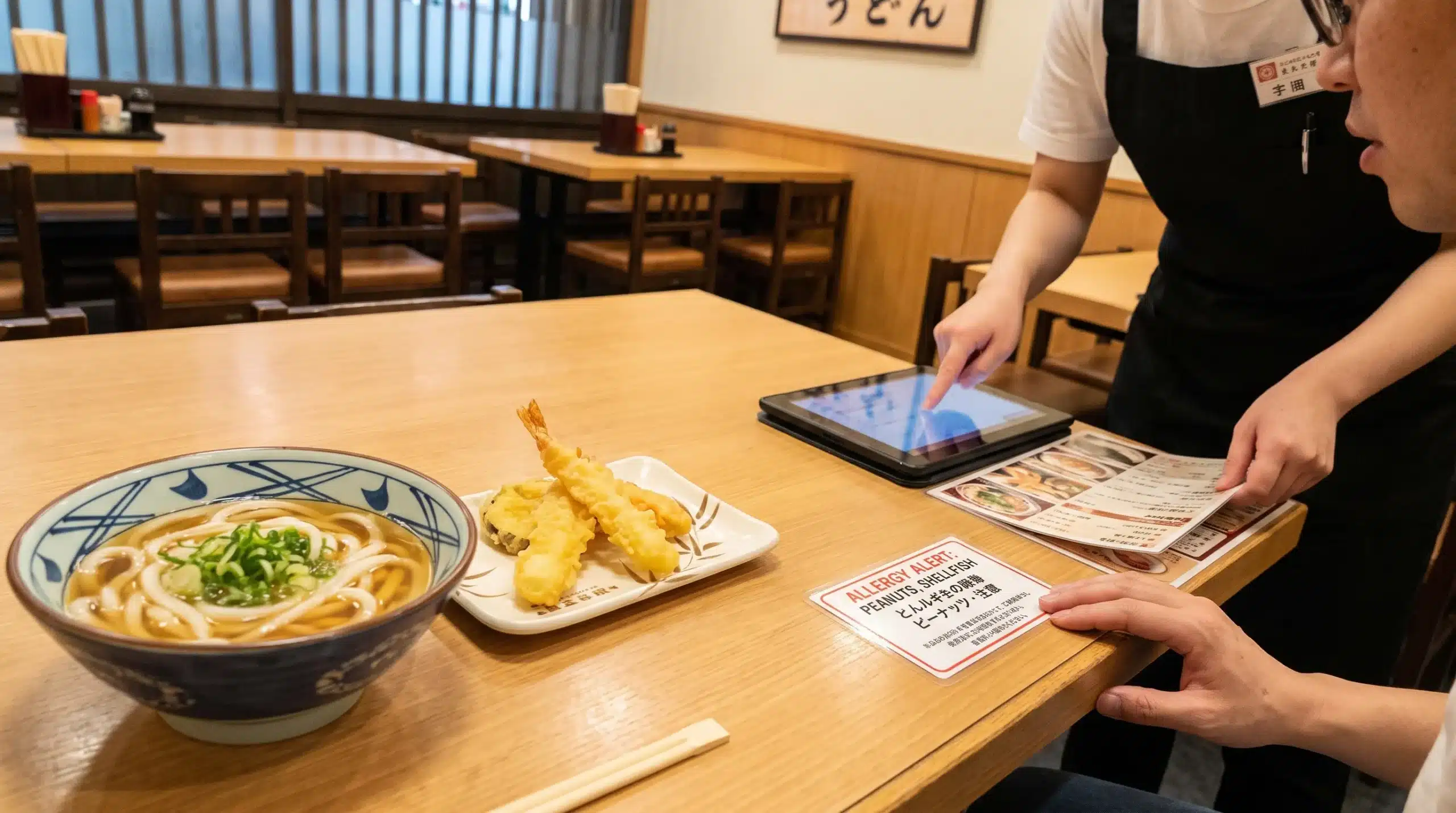
| Tempura | The batter, dipping sauce or fryer may be unsuitable | Flour, dashi sauce and fryer use |
| Salads | Sesame dressing is common | Dressing, oil and toppings |
| Plain grilled food | Marinade or grill surface may be shared | Marinade, brush, grill and utensils |
What Japanese allergen labelling does and does not cover
Japan operates a food allergen labelling system for packaged food. A limited number of allergens are mandatory on labels, and a longer list is recommended rather than required. The details can change, so treat the principle as stable but verify the current list before travelling through the Consumer Affairs Agency food labelling information or another official source.
The key limitation is scope. Japanese food allergen labelling is mainly useful for packaged products, not restaurant meals prepared to order. Convenience store rice balls, supermarket meals, snacks and bottled sauces may carry allergen information. A small restaurant menu, handwritten special or ryokan dinner is not covered in the same way.
For food allergies in Japan restaurants, packaged-food labelling is a useful fallback rather than a restaurant solution. Larger chains sometimes publish allergen charts, but those charts may not answer questions about shared fryers, modified dishes, seasonal sauces or preparation surfaces.
If you will be in Japan for more than a few days, learning to recognise the characters for your relevant allergens is worth the effort. Do not rely only on the English front label. The detailed ingredient and allergen information is usually in Japanese.
The word "allergy" does not always translate as you expect
The Japanese word アレルギー, usually written as arerugī in Roman letters, is understood. The problem is not the word itself. The problem is what the restaurant understands you are asking them to do.
A request may be received as a preference, dislike or dietary choice, particularly if it is communicated through a translation application. “I cannot eat shrimp” may result in the visible shrimp being removed while the broth, paste or frying oil remains unchanged. The kitchen may believe it has helped.
This is why food allergies in Japan restaurants often require a full explanation in Japanese. The explanation should state that it is a medical allergy, identify the allergen and its hidden forms, explain that stock, sauces and shared oil matter, and ask whether the restaurant can accommodate the requirement at all.
A small restaurant may not have the vocabulary or time to work through this at the door, especially during service. That does not mean staff are careless. It means the conversation is happening too late.
Why allergy cards help but are not enough
A well-written allergy card in Japanese is useful. It gives the restaurant the correct words, avoids pronunciation problems and can be shown to several staff members. A card is especially valuable when it includes hidden sources, such as dashi for fish allergy or soy sauce for wheat allergy.
The limitation is that an allergy card cannot ask follow-up questions. It cannot establish whether the stock is made in-house or bought in, whether the fryer is shared, whether the sesame oil is used in the pan, or whether the chef has read and understood the card. It also cannot judge a vague answer.
For food allergies in Japan restaurants, the card should be treated as the start of the conversation, not the conclusion. A card handed over at a busy counter may be read quickly, acknowledged politely and acted on only partially.
A useful card should be specific. “No nuts” is weaker than naming peanuts, tree nuts and the forms that matter to you. “No wheat” is weaker than explaining soy sauce, batter, noodles, marinade and shared fryers. The exact wording should match the allergy and the level of risk, and should avoid casual phrasing that sounds like preference.
Cross-contamination in small Japanese kitchens
Many good Japanese restaurants are small. A counter may have one grill, one fryer, limited preparation space and a small team working at speed. Cross-contamination, often called cross-contact in allergy settings, is a physical constraint in that environment, not necessarily carelessness.
A tempura restaurant may have one fryer. A yakitori counter may use one grill and the same brush for sauce. A ramen shop may use one set of baskets for noodles and one stock system. A sushi counter may wipe surfaces carefully and still handle multiple seafood items in the same space.
When food allergies in Japan restaurants involve shared fryers, shared grills or airborne flour in a small kitchen, the honest answer may be no. A restaurant declining to serve you is responsible behaviour, not rejection. It means staff have understood the risk well enough not to pretend.
This is one of the clearest signs of a serious conversation. A confident yes after a vague explanation is not always reassuring. A careful no, or a request for time to check with the chef, is often the better response.
The single most important rule: ask before you book, not at the door
The practical rule for food allergies in Japan restaurants is simple: ask before you book, not when you arrive. Advance notice gives the kitchen time to check stock, sauces, supplier ingredients and preparation methods. It also gives the restaurant permission to say no before you have built your evening around the meal.
This matters especially for set meals, kaiseki and ryokan dinners. These meals are planned and purchased in advance. Ingredients may be ordered days before service, sauces may already be prepared and the menu may be fixed for the whole room. Adapting the meal on the evening is often impossible.
Advance contact should be specific. The question is not only “Can you handle an allergy?” It is “Can you prepare a meal without this allergen, including stock, sauces, marinades, garnish, shared fryer, shared grill and preparation surfaces?” If the answer is unclear, choose somewhere else.
Convenience stores and supermarkets
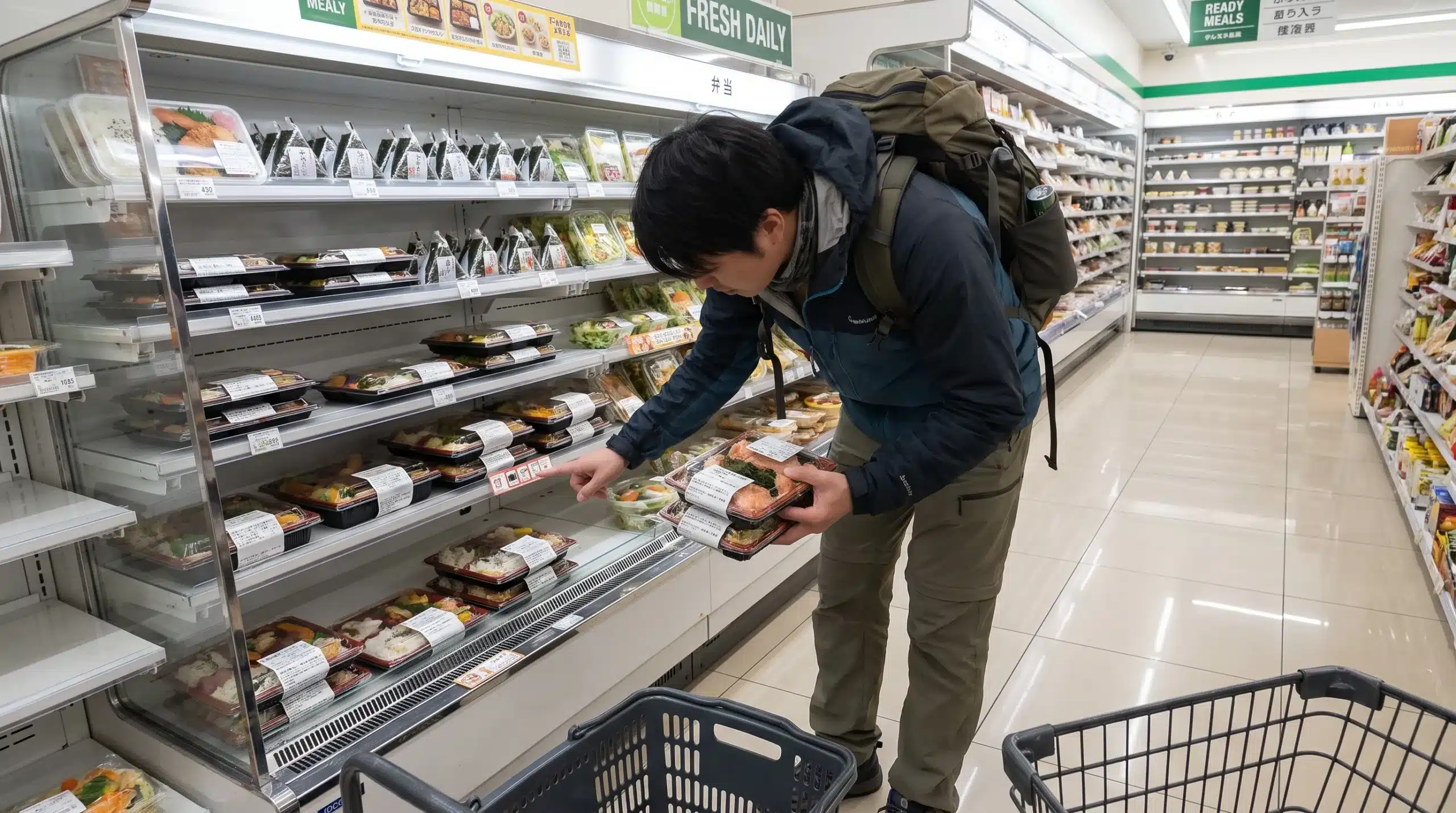
Convenience stores and supermarkets are often the most reliable fallback because packaged food carries allergen labelling. That does not make every product suitable, but it gives you information that many restaurants cannot provide on the spot.
For food allergies in Japan restaurants, it is sensible to have a fallback plan that does not depend on a kitchen conversation every time. Rice balls, packaged rice, fruit, plain yoghurt, prepared meals, snacks and drinks all require checking, but the information is usually printed. Some products also display allergen icons, although you should still read the detailed Japanese label where possible.
Learning the relevant characters before travel reduces dependence on staff and translation applications. At minimum, learn the words for your allergens and the words commonly used around ingredient lists and allergen warnings. A translation application can help with a label, but it should not be your only safety process.
Supermarkets can be easier than restaurants for families with allergic children because the decision can be made slowly, under good light and without pressure from a queue. If you are staying somewhere with a refrigerator or basic kitchen facilities, packaged food can reduce the number of restaurant decisions you need to make.
What to carry, and what to check before you fly
Carry your own medication and emergency plan as advised by your doctor. Do not assume that the same product, formulation or brand is available in Japan, and do not wait until arrival to check the rules. Japan restricts the import of certain medications, including some items that may be ordinary in other countries.
Before departure, check the current requirements through official sources such as the Ministry of Health, Labour and Welfare information on bringing medicines into Japan and your nearest Japanese embassy or consulate. If documentation is required, arrange it well before you fly.
In Japan, the emergency number for an ambulance is 119. This article does not give medical advice, dosage advice or treatment instructions. Those questions belong to your doctor, your allergy specialist or qualified medical staff.
You should also carry your allergy information in several forms: a printed Japanese card, a copy on your phone, the allergen names in Japanese and your doctor’s written advice if relevant. If the allergy applies to a child, the parent or guardian should keep control of the information and decision-making throughout the meal.
How Japan Hand handles it
For food allergies in Japan restaurants, Japan Hand focuses on communication before the meal, not reassurance after arrival. A helper telephones the restaurant in Japanese in advance and asks specific questions to someone who knows the kitchen. Those questions cover stock, sauces, marinades, batter, shared fryers, shared grills, preparation surfaces and any other hidden source relevant to the allergy.
Japan Hand books only where the answer is clear enough to proceed. That is not a guarantee that a meal is safe or allergen-free. It means the restaurant has been asked the right questions in Japanese and has given an answer that can be understood. If a restaurant cannot accommodate the requirement, or if the answer is vague, we say so plainly and look for another option.
This work can be arranged through Japan Hand Allergy & Dietary Help, and it often works together with Restaurant Booking Help when a reservation and kitchen confirmation are both needed. For serious allergies, a helper can also accompany you through Dining Escort and speak to staff directly at the restaurant, including if the menu changes or a dish needs to be checked again.
Helpers are available nationwide, not only in Tokyo and Kyoto. This matters in regional cities, small towns, islands and rural destinations where English support is limited and allergy processes may be unfamiliar. Helpers can also work in a range of languages beyond English where available, so the explanation to you and the conversation with the restaurant do not depend on a chain of imperfect translations.
If you need help with an allergy or dietary requirement in Japan, start with the Allergy & Dietary Help service page and use the contact form there. Tell us the exact allergy, who it applies to, where you will be, your dates and the language you prefer. Japan Hand will tell you what is possible and provide a quote before anything is agreed, with no obligation.