Build a Japan Itinerary That Allows Time for Transfers
Build a Japan Itinerary That Allows Time for Transfers
A Japan itinerary can look manageable on a map and still leave too little time to change stations, collect luggage or reach a hotel. Published train journey times describe only part of that movement. They do not include checking out, finding a lift, buying food or travelling from the arrival station to your accommodation.
The practical approach is to reserve complete transfer blocks before adding activities. Keep arrival days light, limit unnecessary hotel changes and check the connections that would cause a significant problem if missed.
Build transfer time into your Japan itinerary
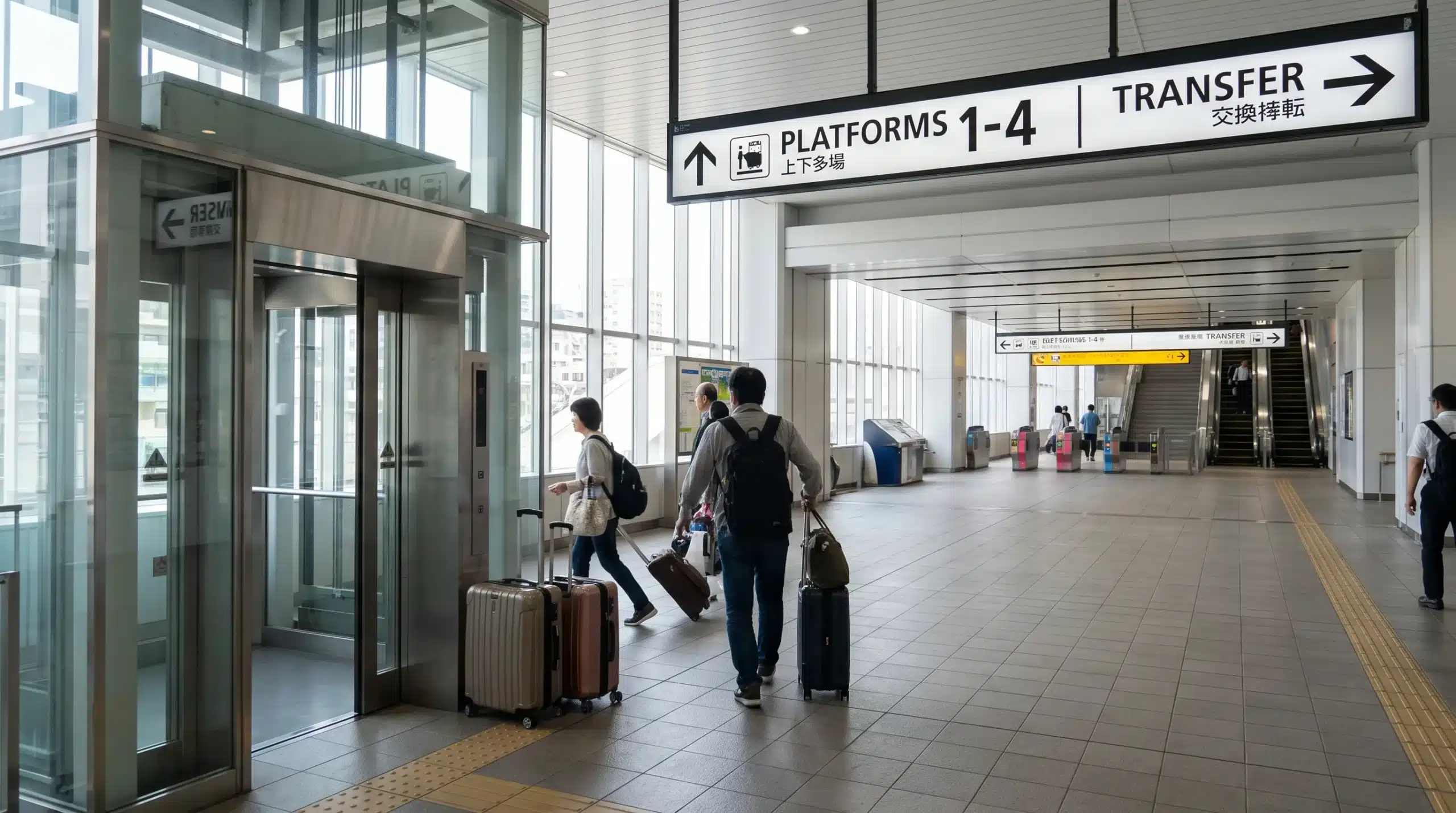
Treat each change of base as a door-to-door journey, not a train booking. Work backwards from any fixed commitment, including accommodation reception hours, a restaurant reservation or a ferry departure.
The following is an illustrative planning exercise for a two-hour train journey. These are assumed allowances, not published journey times or recommended minimums.
| Part of the move | Illustrative allowance |
|---|---|
| Hotel to departure station | 20 minutes |
| Finding the correct entrance, facilities and platform | 30 minutes |
| Train journey | 2 hours |
| Leaving the arrival station | 25 minutes |
| Onward travel to accommodation | 20 minutes |
| Meal or practical stop | 25 minutes |
| Total reserved time | 4 hours |
Your route may need less time or considerably more. A step-free interchange, several suitcases or a separate ticket purchase can change the calculation.
For your Japan itinerary, record the full transfer block in the calendar. If a route has a two-hour train ride but takes four hours door to door, those four hours are unavailable for sightseeing. Check-in may require a further wait if you arrive before your room is ready.
Choose bases before choosing daily activities
Every hotel change creates work: packing, checking out, transporting bags and establishing yourself somewhere new. An additional overnight stop should offer enough benefit to justify that disruption.
For a first visit, several nights in one well-connected base usually provide more flexibility than a sequence of single-night stays. Tokyo and Kyoto can each support multiple days without changing accommodation. Visiting Osaka from Kyoto, or Kyoto from Osaka, may be more practical than moving hotels, depending on your planned districts and onward route.
A workable Japan itinerary also distinguishes between a convenient station and a convenient hotel. Accommodation beside a major interchange can still involve a long internal walk. Check the actual station exit, the walking route and any accessibility requirements rather than relying on the station name alone.
If you have a choice of international arrival and departure airports, compare the complete route before booking. Arriving in one region and leaving from another can remove backtracking, but only if the flight arrangements suit your needs.
A 14-day outline with protected transfer days
This example assumes arrival in the Tokyo area and departure through Kansai. It includes a regional stay in Takamatsu and a final night near the departure airport. It is a planning framework, not a route that suits every flight.
| Day | Base or movement | What to protect |
|---|---|---|
| 1 | Arrive and reach Tokyo accommodation | Entry procedures, transport and check-in |
| 2 to 5 | Tokyo | Local activities grouped by area |
| 6 | Tokyo to Kyoto | A substantial transfer block and a flexible evening |
| 7 to 10 | Kyoto | Local days, with an optional Osaka visit |
| 11 | Kyoto to Takamatsu | Intercity connections and accommodation arrival |
| 12 | Takamatsu | A local day, or an island visit after checking ferries |
| 13 | Travel to the Kansai departure-airport area | A buffer before the international flight |
| 14 | Depart | Airline check-in and airport procedures |
The value of this Japan itinerary is the separation between moving and doing. Day 11 is not also assigned a distant attraction, a timed experience and a restaurant reservation.
The final airport-area night is deliberate, although it adds another hotel change. If the regional section creates too much movement, remove it rather than compressing everything else. Fourteen days do not require fourteen different places.
Keep airport days separate from ordinary city travel
Arrival day
An aircraft's scheduled landing time is not the time you will leave the airport. Entry procedures, baggage collection, connectivity arrangements and finding onward transport all come afterwards.
Avoid committing to a non-refundable activity shortly after arrival. If you must continue to another region that day, check the consequences of missing your intended connection and identify a later workable option.
Accommodation arrangements also matter. Confirm reception hours, late-arrival procedures and whether luggage can be stored before check-in. Small properties may not have someone available throughout the day.
Departure day
A Japan itinerary should work backwards from the airline's current check-in and baggage deadlines, using the correct terminal. Add the full hotel-to-terminal journey and a contingency appropriate to the route.
For a rural departure point, an island or an infrequent airport bus, travelling towards the airport the previous day may be more practical than relying on the earliest service.
Include transport to your departure airport at home in the same planning process. For a journey beginning in the Netherlands, Stuur Chauffeurs' chauffeur services are one option to discuss for that ground segment. Confirm the collection arrangements separately from any transport or help booked in Japan.
Decide how luggage will travel
Carrying every bag on every train is not always necessary. Hotel-to-hotel forwarding can reduce handling, but it introduces delivery timing and acceptance requirements that must be checked before dispatch.
Ask both properties whether they can handle the shipment, confirm the delivery date with the carrier and keep essential items with you. Do not assume same-day delivery, particularly for longer distances, islands or remote accommodation. Medication, travel documents and anything needed before delivery should remain accessible.
Build luggage arrangements into your Japan itinerary before reserving transfer-day activities. Japan Hand's luggage forwarding support can help with the practical arrangements. The explanation of hotel-to-hotel luggage transfer in Japan covers questions to resolve with accommodation providers.
If you carry large cases, check the train operator's requirements. Several shinkansen routes require advance reservations for oversized luggage. Consult JR Central's current oversized-baggage information for the Tokaido, Sanyo and Kyushu Shinkansen rather than assuming an ordinary seat reservation covers every bag.
Allow more room for regional connections
Outside the busiest corridors, a missed connection can have consequences beyond a short delay. Some rural buses, ferries and local trains run infrequently. The final service may be much earlier than you expect.
Check the complete outward and return journeys directly with the relevant operators. Look for weekday, weekend and seasonal differences, then confirm how you will travel between the station or port and your accommodation.
A Japan itinerary that reaches small towns or islands needs a fallback as well as an outward route. Do not assume that a bus, train and ferry connection is protected simply because a route planner displays them together. Check what happens if the first service is delayed or weather interrupts the crossing.
Japan Hand accepts requests nationwide, including regional airports, small towns, islands and rural destinations. Assistance can help resolve local arrangements or language barriers, but a helper cannot make a cancelled ferry sail or create an additional train service.
Check the plan against your actual needs
Mobility and family requirements: Check lifts, walking distances, seating and toilet access at each interchange. A route with fewer changes may be preferable to the fastest result in an app. Parents should also allow time for feeding, rest and managing luggage without rushing children through stations.
Meals and prayer: Place suitable food and prayer facilities along the route rather than treating them as tasks to solve during a short connection. For allergies, dietary restrictions or halal requirements, confirm details in advance where possible. A restaurant listing alone may not answer questions about ingredients or preparation.
Fixed bookings: Mark the commitments that cannot move, then leave flexible time around them. A Japan itinerary becomes fragile when a long transfer ends immediately before a timed admission or a restaurant booking with strict arrival conditions.
Helpers are available in a range of languages beyond English. Include your preferred language and the practical task when enquiring so that suitable support can be assessed.
Frequently asked questions
How many places should I include in two weeks? Start with two or three main bases, then assess the actual transfer burden. A short airport-area stay may be sensible before departure. Add another destination only after checking what it removes from the rest of your schedule.
Can I plan a Japan itinerary without local help? Yes. Straightforward routes between major cities are often manageable independently. You may not need a helper if you can handle the route, luggage and booking arrangements yourself. Targeted support is more relevant when a particular transfer or communication task remains difficult.
Should I book an activity on a transfer day? A flexible activity near your accommodation can work. Avoid making a tight onward commitment depend on an on-time arrival. Check cancellation conditions before booking and allow time to store luggage or check in.
Request help with a specific transfer
If a connection remains difficult, Japan Hand's station navigation help can support the practical movement through a station. Send your dates, accommodation addresses, luggage details, preferred language and any mobility requirements through the contact form on Japan Hand. The price depends on the specifics, and every request receives a quote before anything is agreed, with no obligation.