Plan a Japan Osaka Trip With Easier City-to-City Transfers
Plan a Japan Osaka Trip With Easier City-to-City Transfers
Planning a Japan Osaka trip becomes more complicated when the itinerary includes several hotels, unfamiliar stations and luggage that must travel with you. A short train journey does not necessarily mean an easy transfer: reaching the platform, finding a lift and getting from the arrival station to your accommodation can take considerable effort.
Start with the journeys between places, not just the places themselves. Choose accommodation around your actual arrival and departure routes, limit unnecessary hotel changes and decide which bags you need beside you. These decisions leave more time for Osaka without requiring every day to be tightly scheduled.
Choose an Osaka base around your next journey
Osaka does not have one station that serves every purpose. The most useful hotel location depends on where you arrive, what you plan to do and where you go next.
| Area | When it can work well | What to check before booking |
|---|---|---|
| Namba | Southern Osaka activities and Kansai Airport journeys using Nankai services | Which Namba station serves your route and how far the hotel is from its entrance |
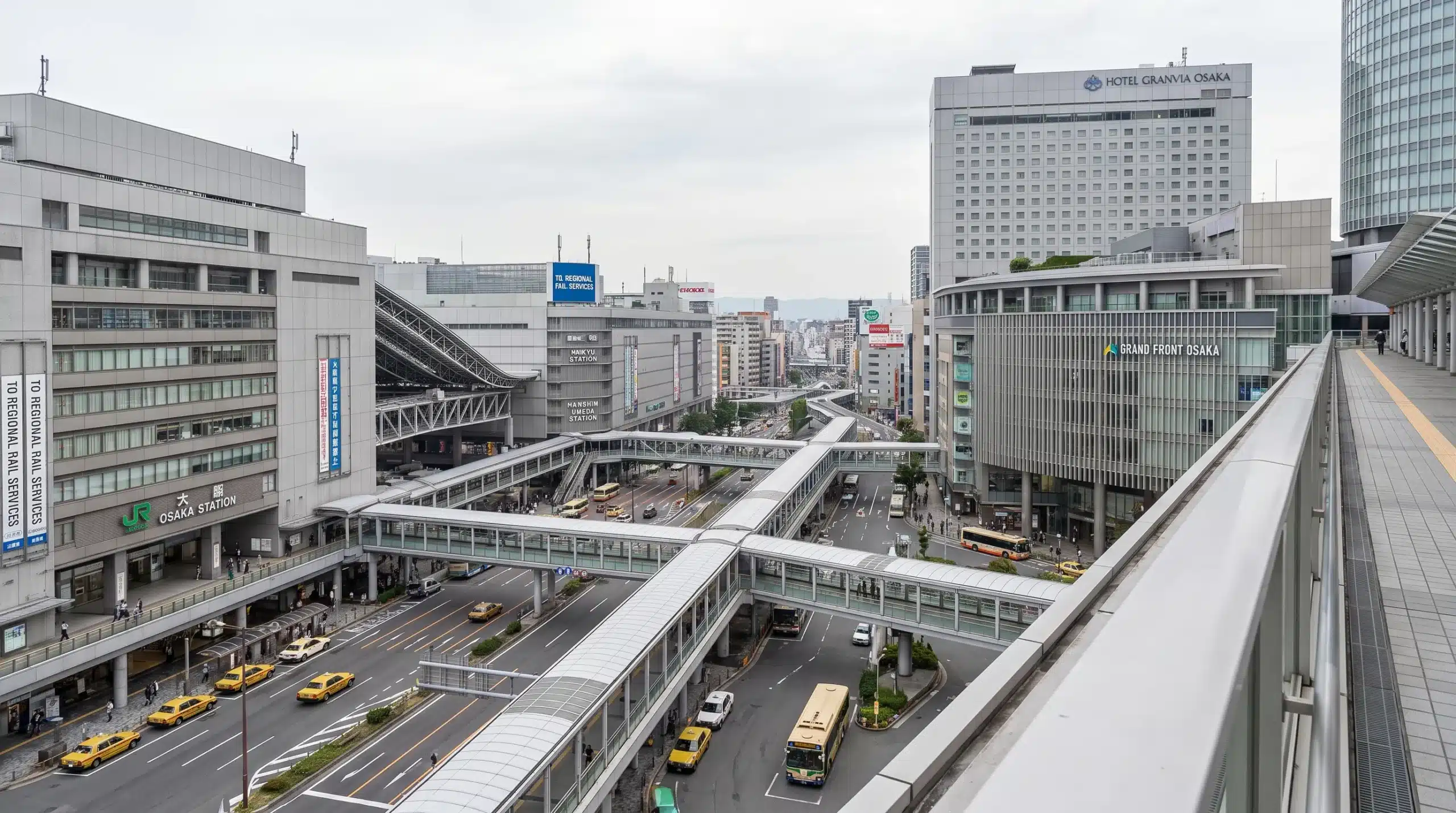
| Osaka and Umeda | Regional rail journeys and connections towards Kyoto or Kobe | The exact operator, station entrance and walking route through the station district |
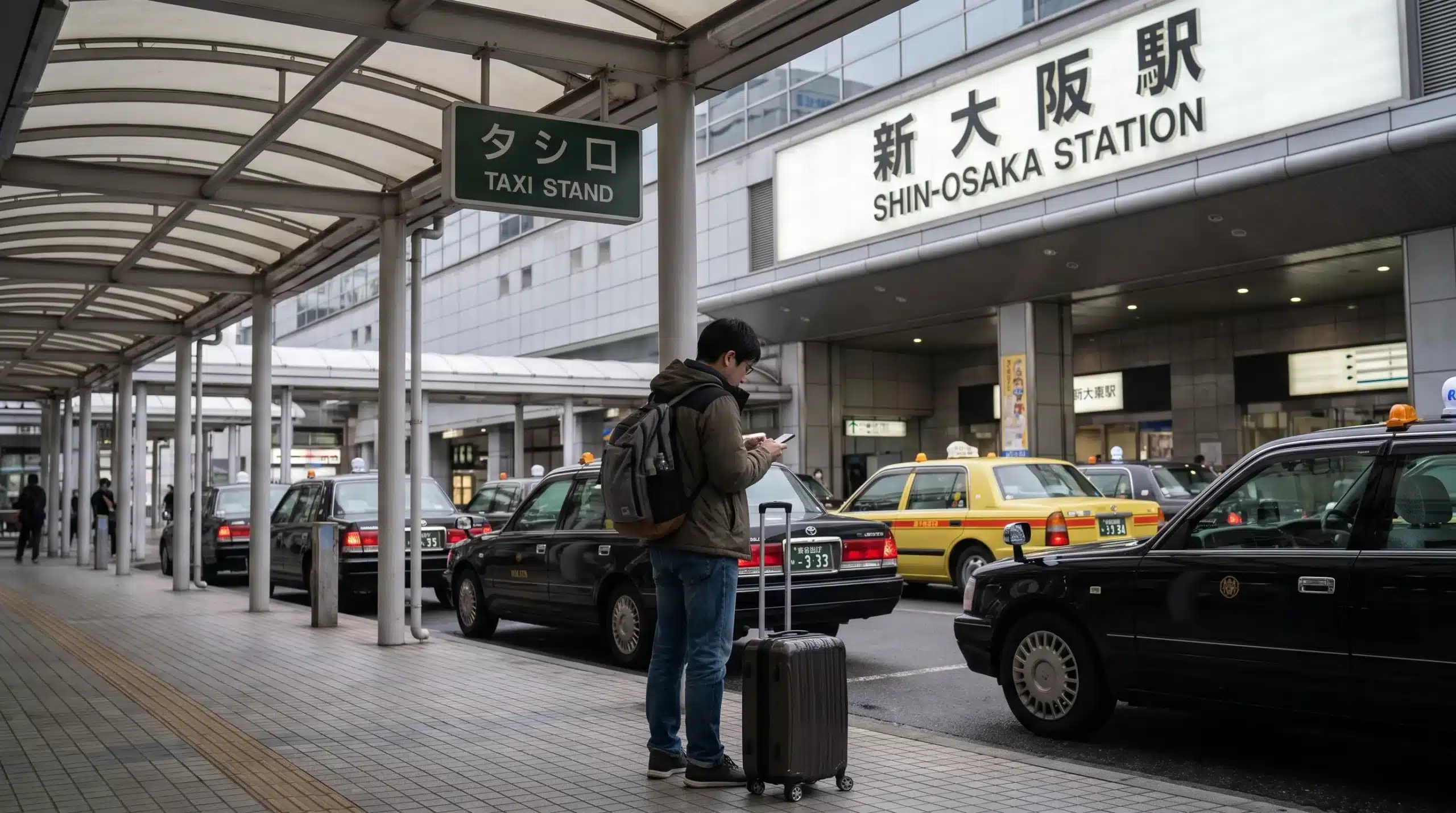
| Shin-Osaka | An early shinkansen departure or a short stop between longer rail journeys | Whether the practical station location outweighs additional journeys into central Osaka |
Osaka Station and Shin-Osaka Station are different stations. Likewise, JR Namba, Nankai Namba and Osaka-Namba are not interchangeable departure points, although they belong to the same wider district.
For your Japan Osaka trip, compare the complete hotel-to-platform journey rather than choosing accommodation solely because its listing says “near the station”. A nearby entrance may still be inconvenient for your line or unsuitable for a step-free route.
Build a Japan Osaka trip around fewer hotel changes
Osaka can serve as a base for visits to Kyoto, Nara or Kobe. You do not automatically need a different hotel in each city. Returning to the same room avoids packing, checking out, storing bags and waiting for another check-in.
Staying in Kyoto becomes more useful when several consecutive days centre on Kyoto, especially if early starts or evening activities matter. That is a reason to move accommodation, rather than moving simply because the cities have different names.
| Available time | A practical starting structure |
|---|---|
| Five or six nights | One Osaka base, with selected regional day visits |
| Seven to nine nights | Osaka plus a second base only where it meaningfully reduces repeated travel |
| Ten to fourteen nights | Osaka followed by another region, with accommodation grouped geographically |
These are planning structures, not fixed itineraries. Allow substantial time within Osaka itself rather than using every day for travel elsewhere.
A Japan Osaka trip that continues towards Hiroshima or Tokyo is usually easier to assess as a sequence of overnight bases. Compare arriving and departing through different airports with returning to your original airport, including the extra rail journey and any final overnight stay.
Match the airport route to your hotel
Kansai International Airport
Kansai International Airport has both JR and Nankai rail connections. Nankai serves Namba, while JR offers routes useful for areas including Tennoji and the Osaka Station district. The appropriate service depends on your destination, ticket conditions and arrival time.
Check the arrival terminal and how to reach the railway station from it. Do not reserve a tightly timed connection based only on the aircraft’s scheduled landing time. Immigration, baggage collection and movement through the airport happen before the onward journey begins.
Osaka Itami Airport
Osaka Itami Airport is a separate airport, primarily serving domestic flights. It does not have a mainline railway station inside the terminal. Airport buses or a monorail journey with an onward connection may suit your destination.
For a Japan Osaka trip involving a domestic connection, confirm the airport code on every booking. KIX and ITM are not terminals of the same airport. Any change between them needs its own realistic transfer plan.
Airport routes, operating arrangements and ticket options can change. Check the airport and transport operator’s current information before departure, then save your chosen route offline.
Book the correct departure station and ticket
For shinkansen journeys from Osaka towards Tokyo or Hiroshima, the station to identify is Shin-Osaka. Allow time to reach it from your hotel, navigate to the correct gate and find the platform without rushing.
An intercity journey may involve separate local and long-distance services. Check what your ticket actually covers rather than assuming that an IC card, regional pass or nationwide rail pass covers every stage. A nationwide pass is not automatically the least expensive option for an Osaka-centred itinerary; compare the journeys it includes before buying.
Seat arrangements also matter when travelling with children, mobility equipment or large suitcases. Several shinkansen routes require advance reservations for oversized luggage. Check JR Central’s current oversized-baggage rules where relevant and measure your bags before selecting seats.
Build each rail transfer in your Japan Osaka trip around four details: the departure station, the operator, the ticket arrangement and the arrival station. Save the accommodation address in Japanese as well, since the final journey may require a taxi or a conversation with station staff.
Carry less between overnight bases
Luggage forwarding can remove a difficult suitcase journey, but it requires advance coordination. Confirm that the sending property can arrange dispatch and that the receiving accommodation accepts deliveries addressed to guests. Do not assume same-day arrival or reception facilities at an unattended apartment.
The useful question is not simply whether forwarding is available. It is whether the delivery schedule fits your next stay. Sending a large suitcase to a later hotel can work better than sending it to accommodation where you will stay only briefly.
Keep documents, necessary medication, valuables, chargers and enough clothing for the confirmed delivery interval in your personal luggage. Japan Hand’s explanation of hotel-to-hotel luggage transfer covers the checks needed before handing over a bag.
Small valuables need little space when packed carefully. Everyday accessories, such as pieces from LUMOIR’s stainless steel jewellery collection, can travel in a compact protective pouch in your personal bag rather than a separate case in forwarded luggage.
For a Japan Osaka trip with only one hotel change, carrying your own bags may remain the simpler option. Assess suitcase size, station access and your ability to manage everything together before arranging an additional service.
Use a repeatable transfer-day checklist
Prepare the next move before checking out. A short written plan is more useful than several disconnected booking screenshots.
- Confirm the destination: Save the hotel name, Japanese address and reception arrangements.
- Check the departure point: Record the exact station, operator and booked service where applicable.
- Plan the access route: Find suitable entrances, lifts and the final route from the arrival station.
- Separate essential belongings: Keep tickets, documents and necessary items accessible without opening a large suitcase.
- Leave recovery time: Avoid placing an inflexible restaurant or attraction booking immediately after an intercity arrival.
Parents and guardians should assess the route with children and luggage together, not as separate considerations. A connection that is manageable with a small backpack may be impractical with a pushchair and several bags.
For older travellers or anyone with mobility requirements, confirm the full step-free route rather than relying on a station’s lift symbol. Platform access does not establish whether the hotel approach has steps, steep gradients or suitable crossings.
Keeping the same transfer checklist throughout your Japan Osaka trip reduces the number of decisions required on each departure morning.
Request help for a defined task
You may not need paid support for a straightforward journey with manageable luggage. Hotel reception staff, transport information counters and clearly documented routes can be sufficient.
Help becomes more useful when the difficulty is specific: accompanying you through an unfamiliar interchange, checking a step-free route or speaking with accommodation about luggage acceptance. Japan Hand’s station navigation help can be requested for practical assistance rather than a sightseeing itinerary.
Describe the task precisely when enquiring. Include the stations, travel date, luggage, mobility requirements and preferred language. Japan Hand offers helpers in a range of languages beyond English and operates nationwide, including regional airports, small towns, islands and rural destinations. Confirm arrangements for your particular location and date.
A helper cannot guarantee a reserved seat after services have sold out or prevent disruption. For your Japan Osaka trip, request support where it resolves an identifiable problem, while retaining a workable alternative if transport plans change.
Frequently asked questions
Should I stay in Osaka or Kyoto? Choose the base that reduces your total daily travel. Osaka can suit a mixed regional itinerary; several consecutive days focused on Kyoto may justify staying there instead.
Can I visit Kyoto without changing hotels? Yes. Rail connections make a day visit practical, but include travel between your hotel, the station and your intended destinations when assessing the day.
Do I need help to change trains at Shin-Osaka? Not necessarily. Many travellers manage independently. Consider assistance if luggage, mobility requirements, language difficulties or an unfamiliar connection make the transfer difficult.
Can Japan Hand arrange luggage support outside Osaka? You can request nationwide support, including regional destinations. Delivery feasibility depends on the addresses, accommodation arrangements and available transport time, so provide the full itinerary for assessment.
Arrange the support you need
For assistance with moving bags between stays, see Japan Hand’s luggage transfer support. Submit your route and requirements through the contact form on Japan Hand. The price depends on the specifics, and you will receive a quote with no obligation before anything is agreed.