How Home Japanese Food Differs Across Regions
Finding home Japanese food while travelling can be difficult because a region’s most advertised dish is not necessarily what its households eat. Restaurant specialities, festival snacks and ordinary dinners overlap, but they are not interchangeable.
The more useful question is what changes in the kitchen: the stock, the seasoning, the vegetables available that week and the ingredients a family preserves. Those differences help explain why a familiar bowl of soup can taste quite different in another prefecture.
Regional traditions also sit alongside modern routines. Curry rice, pasta, supermarket side dishes and reheated leftovers belong to contemporary home life too. The examples below describe patterns and local dishes, not rules that every household follows or a checklist of foods you need to find.
How home Japanese food differs across regions
Climate, agriculture and access to the sea have shaped regional cooking. Preservation methods such as salting, drying, pickling and fermentation helped households keep seasonal ingredients available beyond harvest or fishing periods.
Those influences remain, but regional boundaries are not rigid. Families move, recipes circulate and supermarkets sell ingredients from across Japan. A household’s preferences, working hours and generation can matter as much as its location.
A quick regional comparison
| Region | Useful examples | What to notice |
|---|---|---|
| Hokkaido | Sanpeijiru, salmon chanchanyaki | Fish, vegetables and warming preparations |
| Tohoku | Yamagata imoni, preserved vegetables | Root crops, seasonal gatherings and preservation |
| Kanto | Simmered dishes using dark soy sauce | Colour and seasoning, without assuming every dish tastes strong |
| Chubu | Niigata noppe, Aichi bean-miso dishes | Considerable differences between neighbouring areas |
| Kansai | Kyoto obanzai, stock-led soups | Dashi, seasonal vegetables and contrasting soy sauces |
| Chugoku and Shikoku | Okayama bara-zushi, Sanuki udon | Household adaptations of rice and noodle traditions |
| Kyushu and Okinawa | Chikuzenni, goya champuru | Distinct local seasonings and ingredients |
Use this comparison to recognise home Japanese food traditions, not to predict what every household will serve. The Ministry of Agriculture, Forestry and Fisheries’ Our Regional Cuisines collection provides a useful reference for individual dishes and their local backgrounds.
Hokkaido and Tohoku: fish, root vegetables and preservation
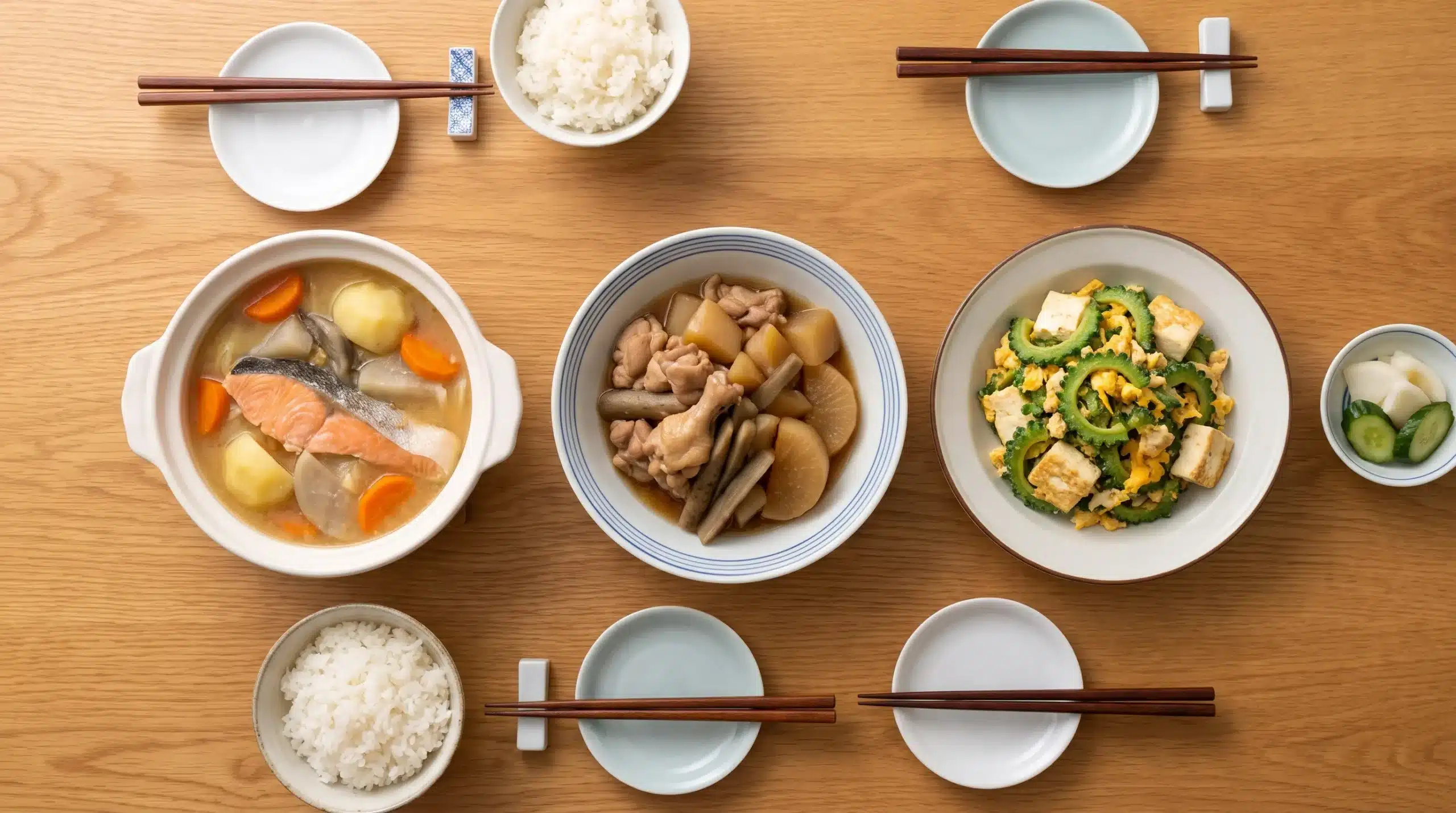
Hokkaido’s sanpeijiru combines salted fish with vegetables in a soup. Salmon chanchanyaki brings fish and vegetables together with a miso-based seasoning, although it is also associated with shared outdoor cooking rather than only the domestic kitchen.
In Tohoku, preserved vegetables and warming dishes form part of many local traditions. That does not mean every meal is heavy or salty. Fresh mountain vegetables, summer produce and locally caught fish also change the table through the year.
Yamagata’s imoni, a taro-based stew, demonstrates how specific the differences can be. Inland versions commonly use beef and soy sauce, while versions in the Shonai area commonly use pork and miso. Even one prefectural dish does not have a single universal recipe.
Kanto and Chubu: familiar ingredients, different foundations
Dark soy sauce, or koikuchi shoyu, is widely used in Kanto cooking. It can give simmered vegetables and other dishes a darker appearance, but colour alone does not tell you how salty or strongly seasoned a meal will be.
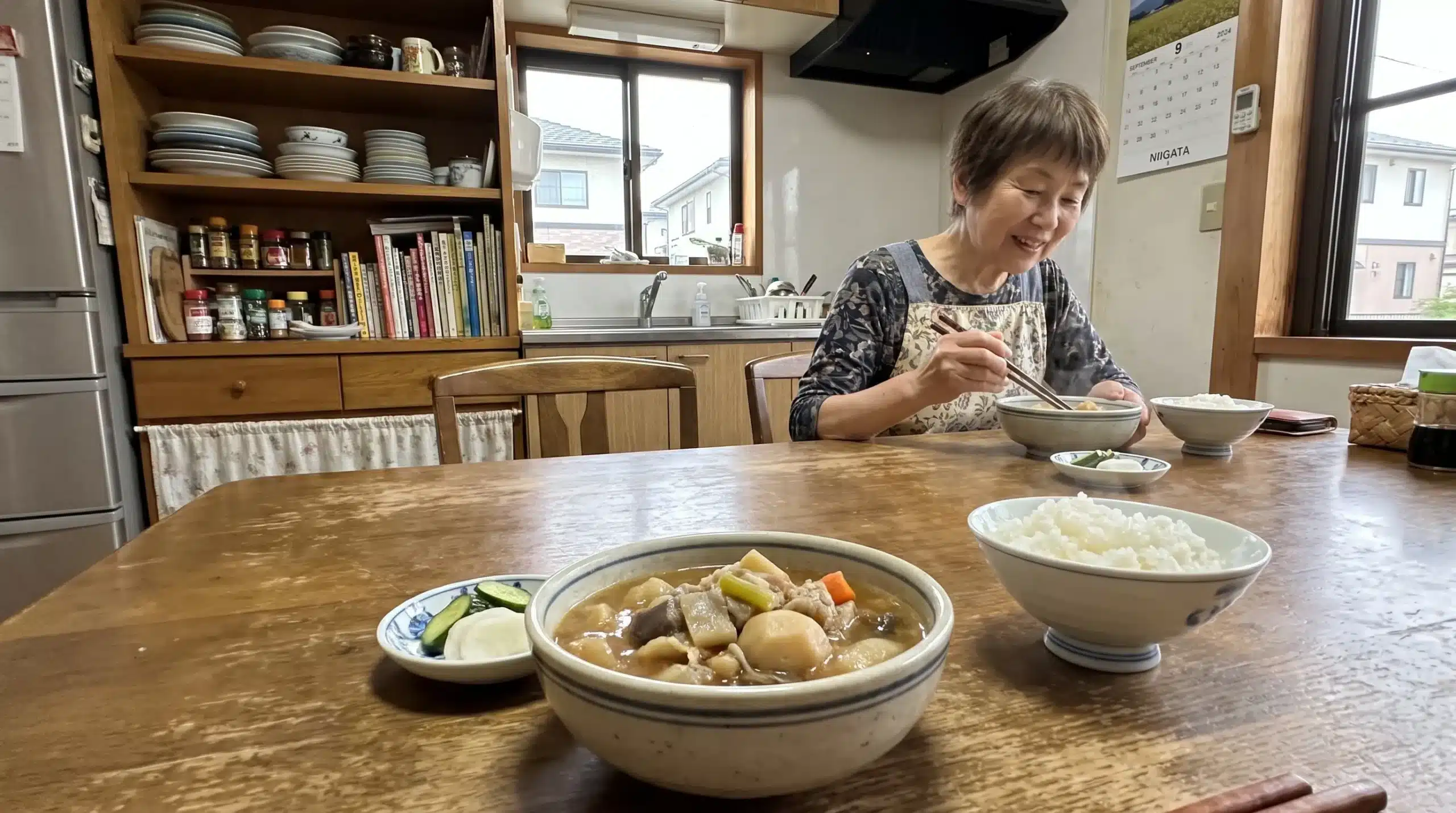
Chubu is particularly difficult to summarise because it includes coastal, mountain and inland communities. Niigata’s noppe brings together vegetables such as taro with ingredients that vary by household and occasion. Around Aichi, soybean-based miso contributes a different flavour from the rice-miso varieties found elsewhere.
When comparing home Japanese food, ask which miso or stock is being used rather than simply whether the dish is “traditional”. A bowl of miso soup may look familiar while its fermented ingredients, vegetables and balance of flavours differ substantially.
Kansai, Chugoku and Shikoku: stock, vegetables and occasion
Kansai cooking is often associated with an emphasis on dashi and the appearance of individual ingredients. Light-coloured usukuchi soy sauce is used in some preparations, but lighter colour does not mean lower salt content.
Kyoto’s obanzai refers to a tradition of household-style dishes associated with the city. Seasonal vegetables, tofu products and carefully used leftovers can all belong within that tradition. Restaurant presentations may be more elaborate than an ordinary household meal.
Further west, Okayama’s bara-zushi illustrates the importance of occasion: decorated mixed sushi is not necessarily an everyday dinner. In Kagawa, Sanuki udon belongs to both restaurant and household eating. A regional food can be familiar at home without being made entirely from scratch there.
Kyushu and Okinawa: differences that a single label misses
Home Japanese food in Kyushu and Okinawa cannot be reduced to one southern style. Sweetened soy sauces are common in parts of Kyushu, but preferences vary between places, producers and households.
Fukuoka’s chikuzenni combines chicken and vegetables such as burdock, lotus root and carrot in a simmered dish. It can appear at family meals as well as celebrations, with ingredients and preparation adjusted to the household.
Okinawa has a distinct culinary history. Goya champuru, a stir-fry commonly combining bitter melon, tofu, egg and pork, shows a different set of everyday ingredients from the northern soups described above. Bitter melon’s taste is bitterness, not chilli heat. Other champuru preparations use different vegetables or ingredients, so the name does not identify one fixed recipe.
Season and household matter as much as region
A regional comparison becomes more useful when you add the season. Spring mountain vegetables, summer aubergines, autumn mushrooms and winter radishes can change the same household’s meals considerably. Availability also depends on local growing conditions and shopping habits.
The familiar arrangement of rice, soup and several accompanying dishes is one model, not a requirement at every meal. Noodles, rice bowls, hotpots and one-dish meals are equally relevant to understanding daily cooking.
Celebration foods need separate interpretation. A dish associated with New Year, a harvest gathering or a family occasion may be well known locally without appearing regularly on a weekday table. Ask when people usually eat it, not only where it comes from.
Finding home Japanese food during a visit
A regional restaurant menu is not a direct record of household eating. For something closer to an ordinary meal, look for a small restaurant serving teishoku, meaning a set meal, or a shop selling sozai, prepared side dishes. Neither label guarantees local ingredients or a family recipe, but both can help you look beyond famous specialities.
A useful question is: “What do people here commonly cook at home in this season?” Follow it with questions about the soup, vegetables or seasoning. This is more informative than asking for the region’s most famous dish.
For an arranged household meal, establish what is actually offered before making plans. Our article on arranging a Japanese home-cooked meal respectfully covers that separate process. A restaurant serving household-style food is not the same as an invitation into someone’s home.
Japan Hand handles help requests nationwide, including small towns, islands and rural destinations. Helpers work in a range of languages beyond English. Confirm the language and local availability needed for your request; a private household invitation cannot be assumed or guaranteed.
Dietary requirements: check the recipe, not the regional reputation
Regional descriptions cannot establish whether a dish meets an allergy, vegetarian or religious requirement. Vegetable dishes may contain fish stock. Soy sauce commonly contains wheat, some miso contains barley and simmered dishes may use sake or mirin.
A menu translation also cannot confirm substitutions or shared preparation equipment. Japan Hand’s allergy and dietary handling support can help with Japanese-language questions, but only the kitchen can explain its ingredients and practices. Some kitchens cannot accommodate a request.
The label “traditional” does not establish nutritional suitability either. If you use a service such as Custom Fit’s nutrition coaching in San Francisco, bring the specific requirements agreed with your provider rather than relying on broad assumptions about Japanese meals.
Choosing home Japanese food for cultural interest and checking its suitability are separate tasks. For medical dietary needs, follow advice from your qualified healthcare professional. If ingredients or preparation cannot be confirmed adequately, choose another meal.
Frequently asked questions
What is Japanese comfort food? It depends on the household. Curry rice, miso soup, rice balls, udon and hotpots are common examples. Comfort may come from a family’s preparation rather than a dish being unique to its region.
Is Japanese food spicy? Many everyday dishes are not chilli-hot, but exceptions exist. Mustard, wasabi, chilli condiments and spicy preparations can appear. Ask about the particular dish rather than relying on a national or regional description.
Is takoyaki a typical home meal? Takoyaki, batter balls usually containing octopus, is strongly associated with Osaka and is often sold as a snack. Some households make it at home, including for shared meals or gatherings, but it does not represent everyday cooking across Japan.
Ask for help with a specific meal
If a venue publishes a clear menu and can answer your questions directly, you may not need help. Otherwise, Japan Hand’s restaurant booking and dining escort support can assist with enquiries and communication. Send the location, date, preferred language and food requirements through the contact form. Each request receives a quote before anything is agreed, with no obligation.